


Investing Project
NPV= sum of present value of each cash inflow – initial investment
There are two types for sum of present value of each cash inflow :
1.Annuity
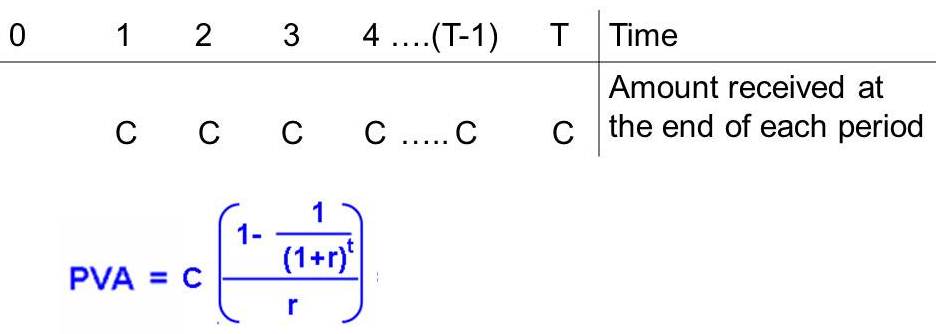
2. Not Annuity


Project decision:
if NPV>0=> accept the project
if NPV<0=>reject the project
if NPV=0=>indifference
Advantage for NPV:
- it regards all period of project life in calculating.
- it considers the time value of invested fund.
Disadvantages for NPV:
- It is more difficult in calculating than payback period and ARR. Therefore, it can not be used by lower level staffs to support their decision.
- At the time of NPV equal 0 managers can choose other investment criteria to support their decision making.
Example:
Suppose fertilizer business earns cash revenue $20,000 per year, and cash cost (including taxes) will be $14,000 per year. We will wind down the business in eight years. The plant, property and equipment will be worth $2,000 as salvage at that time. The project costs $30,000 to launch. We use a 15 percent discount rate on new project. Is this a good investment? If there are 1,000 shares of stock outstanding , what will be the effect on the price per share of taking this investment?
Solution:
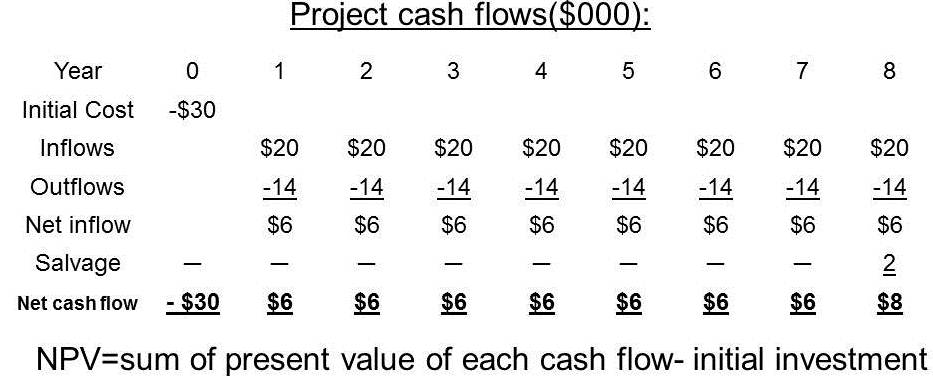
- Present Value
Present Value = C*{ [(1-1/(1+r)^t)]/r}+F/(1+r)^t
=$6,000*{ [(1 1/(1+0.15)^8)]/0.15}+$2,000/(1+0.15)^8 =$27,578
- Initial Investment
Initial investment =$30,000
NPV=$27,578 – $30,000=-$2,422<0
Therefore, this is not a good investment. Based on our estimates, taking it would decrease the total value of the stock by $2,422. with 1,000 shares outstanding, our best estimate of the impact of taking this project is a loss of value of $2,422/1,000=$2.42 per share.
Source:
- Mcgraw-Hill – Fundamentals Of Corporate Finance
- Phnom Penh HR