


Cost of Inventory-Products for manufacturing company
Cost of Inventory for manufacturing company
The examples of manufacturing company are as follows.
- Company manufactures and sells phones, computers, scanners, LDC
- Company manufactures and sells cars, motor
- Company manufactures and sells furniture
- Company manufactures and sells TV
Cost of finished goods = cost of material + conversion cost
Cost of material = purchase price-trade discount-sale return and allowance+ freight + insurance + import taxation + Specific tax (if any) + port fee + clearance cost + other relevant costs
Note:
- Settlement discount because of early payment is excluded cost of inventory, so it is other income.
- VAT input is excluded cost of inventory if it can be claimed from VAT output when we sell inventories.
Conversion Cost- it included directs costs and production overheads. Direct cost included direct labor while Production overheads included heating and light, salary of supervisors, depreciation of plant, etc.
Our note:
- Cost of material refer to direct materials for this case
- Conversion costs are cost converting from direct materials to finished goods.
In practice, cost of finished goods= material + labour +overhead = specific cost + common cost
Costs are excluded from cost of inventories:
- Selling costs/marketing expense
- Storage costs ( or storage cost of finished goods)
- Abnormal waste of materials, labour or other costs
- Administrative overheads.
Example 1
XYZ Company manufactures and sells Table A. The costs of manufacturing table are as follows.
Wood………………………………..$20
Other materials…………………..$2
Direct labor………………………..$10
Other Production overhead…..$5
Required:
Calculate cost of Table
Solution
Cost of finished goods = cost of material + conversion cost
Cost of finished goods = 20 + (2+10+5)=$37
Cost of Table A is $37.
Example 2
Your company manufactured three products A, B and C.
| Product | Produced Units |
| A | 10,000 |
| B | 5,000 |
| C | 2,000 |
There are specific costs and common costs (absorption cost) for each products as follows:
The following costs are directly allocated ( specific costs) to each product.
| Cost | Product A | Product B | Product C |
| Material | 20,000 | 7,000 | 8,000 |
| Labour | 10,000 | 12,000 | 9,000 |
| Overhead | 4,000 | 2,000 | 2,000 |
| Total | $34,000 | $21,000 | $19,000 |
Below are the common expenses and costs , and percentages/absorption used for three products and admin department.
————–
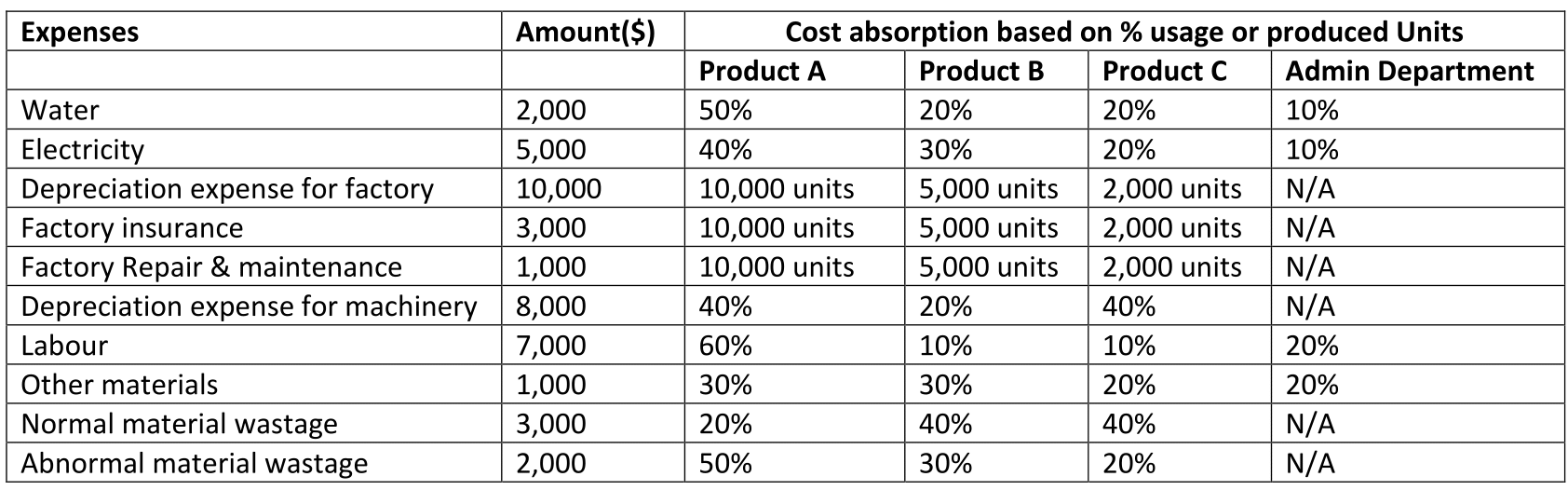
Required:
- Calculate total costs for Product A, B and C
- Cost per unit for Product A, B and C
- Admin Costs
- Other Expense
Solution
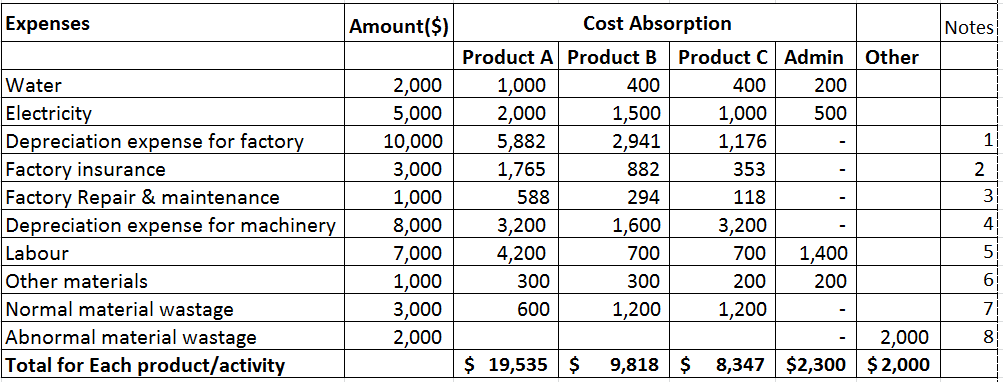
The following notes:
| 1/ 10,000/17,000 x $10,000=5,882$ |
| 2/ 10,000/17,000 x $3,000=1,765 $ |
| 3/ 10,000/17,000 x $1,000=588 $ |
| 4/ 8,000 x 40%= 3,200$ |
| 5/ 7,000 x 60%= 4,200 $ |
| 6/ 1,000 x 30% = 300$ |
| 7/ 3,000 x 20%= 600$ |
| 8/ abnormal cost is other expense |
1.Calculate total costs for Product A, B and C
Total costs = material + labour +overhead = specific costs + common costs
Total Cost for Product A = $34,000 + $19,535 =$ 53,535
Total Cost for Product B =$21,000 + $9,818 = $30,818
Total Cost for Product C =$19,000 + $8,347 = $27,347
2.Cost per unit for Product A, B and C
Cost per unit = Total Costs for Each Product /Produced Units for Each Product
Cost per unit for Product A =$ 53,535/10,000= $5.35
Cost per unit for Product B = $30,818/5,000= $6.16
Cost per unit for Product C =$27,347/ 2,000= $13.67
3.Admin Costs
Admin costs = $2,300
4.Other Expense
Other expense = $2,000